“Onomastics and Genealogy — The Name Game,” by Denise R. Larson
Onomastic used to mean a lexicographer who put proper nouns, such as personal names, in alphabetical lists. Then came along the twentieth century and onomastics transformed into the study of the history and origin of those proper names, under the umbrella of onomasiology, which involves comparing terminology for similar concepts. A professional who works in the field of onomastics is called an onomast — at least since the 1980s when the word took its place in the Os of English dictionaries.
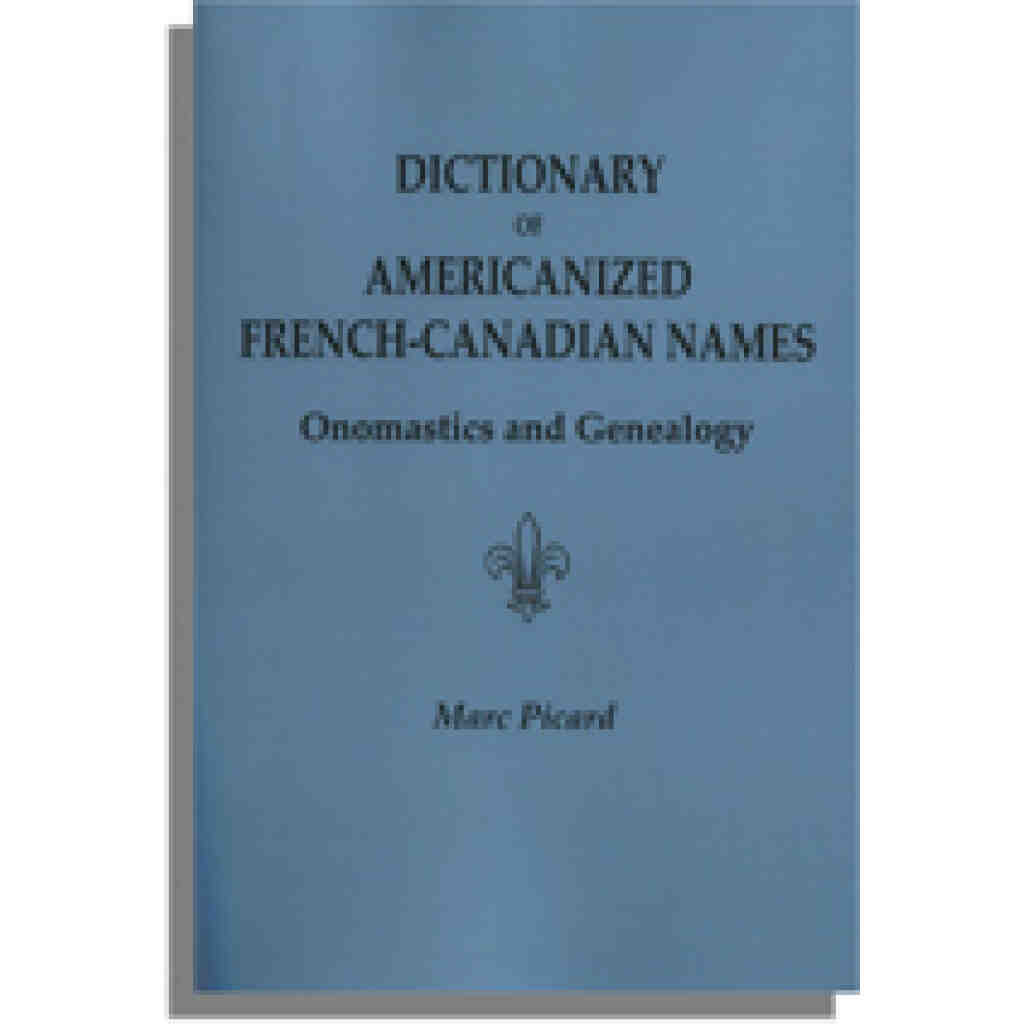
Marc Picard, author of Dictionary of Americanized French-Canadian Names, Onomastics and Genealogy, is an onomast. No doubt about it. His professionalism shines through the pages of his dictionary, giving it an understandably academic tone. I, as reader, would have appreciated a glossary for all the “O” words and a few others, such as lexeme (relates to a family of words) and etymology (origin and metamorphosis of words — think caterpillar to butterfly), but I forgive him because the insight he gives into the development — etymology— of French-Canadian-American names is jaw dropping.
Now that we’re past the scientific jabberwocky (early twentieth century noun meaning invented language), I can say that Picard’s dictionary is readable for the average person, valuable to historians, and enlightening for the family genealogist. Where standard genealogical research runs into a closed door, Picard opens a window to remarkable possibilities in tracing an elusive surname.
Picard approaches the evolution of a family name from the viewpoints of location (origin of progenitor), linguistics (the meaning of a name or its parts), occupation, reputation or nickname, and assimilation. French names were often anglicized for ease of spelling, social reasons, etc., but Picard points out that Hessian soldiers who remained in French Canada accepted the francization (yes, that’s in the Apple Dictionary) of their German names. Some English families did the same. Picard gives an example of a radical change: Farnworth became Pheneuf — which is a good example of why genealogists need onomasts.
Picard’s dictionary is full of tricks of the onomast’s trade, such as when looking for a surname with an initial vowel, try adding an “H.” For some reason the pronunciation of the letter H was virtually discontinued in seventeenth century France, but use of the letter when spelling a name remained, at least for a time. Another secret is that the most common spelling change for a surname in France to the same in Canada was changing the suffix -et to -ette, the second most common was -ot to -otte, and that these were not masculine-to-feminine changes but an action taken to retain the pronunciation of the “t” sound.
Picard is not without a sense of humor. One of his examples of mistranslation of a name takes a surname from the smithy to the cooking pot: The name Lefebvre comes from Old French fe(b)vre and means “blacksmith.” Someone somewhere assumed the name was a version of feve, which means “bean,” and so the famous Mr. Bean might be an Lefebvre in English garb.
Picard’s dictionary includes an extensive A to Z list (of which the original onomastics would be proud) of French-Canadian names that have undergone uncommon changes. Names changed by the popular suffix switch from -et to -ette aren’t there, nor is the -ot to -otte, nor the -el to -elle. What is there are family names that have undergone significant changes, some of which are amazing in the number and type of variation. Most entries include an “original” surname, its origin and meanings, any known North American variations, and genealogical information about the first immigrant to French Canada who bore the name.
For example, under Aucoin is listed: “from the Germanic name Alhwin composed of alah ‘temple’ and win ‘friend’. — Amer. Ocoin, O’Coin, O’Quinn, Wedge.” Following the entry is the parentage, spouse, and marriage date and place of Martin Aucoin from La Rochelle in Seine-Maritime. That entry gave me pause, thinking there might be a family of O’Quinns out there who has no claim to the Emerald Isle and should be looking across the channel for its origins.
Picard provides numerous references for both onomastics and genealogy. Many of the sources are online and new this year, one of which, the Fichier Origine by Marcel Fournier, considers some onomastic spelling changes in its search capabilities. Other sources are tried-and-true reference works, such as the PRDH (Le Programme de recherche en démographie historique) and René Jetté’s monumental Dictionnaire généalogique.
The crux of the matter is that, as Picard wrote in his introduction, there is “no rhyme or reason for most of the (spelling) changes” in French-Canadian family names. Accordingly, I hasten to add, a directory that reveals which direction a surname has taken throughout the generations can save a family genealogist from many wrong turns and dead ends. Just ask an O’Quinn.