

Creating ‘The Book of Merit. Honorary Badges of Distinction’, by Kenneth W. Virgil
“Genealogy Pointers” asked author Kenneth Virgil to describe the multi-year process required to identify the Revolutionary War veterans who who were awarded Badges of Distinction for years of service in that conflict. As you will see, it took not only curiosity and persistence on Mr. Virgil’s part but also a rather specific skill set and ingenuity as well.
One other thing: Despite the very large database Mr. Virgil had to whittle down to produce bona fide recipients of the Badge of Distinction, the initial record collection would have been even larger had it not been for two tragic fires that destroyed even more Revolutionary War records; namely, the New York City fire of 1776, and two War
Department fires in 1800 and 1814 (War of 1812).
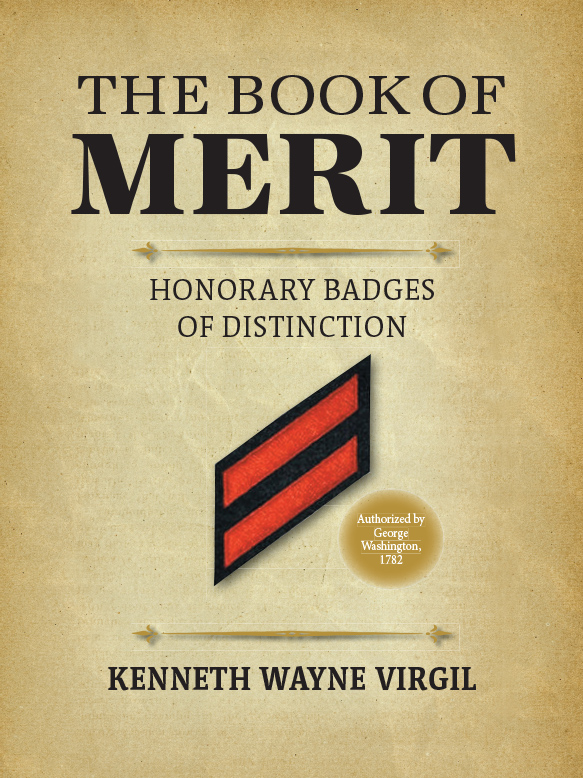
“In 2019, I received a 1980 family document written by Elaine C. Artlip titled ”Meshach Walker and His Family”. While reading it, I discovered that one of my ancestors had served in the Revolutionary War. What began as a genealogical curiosity quickly developed into a larger research effort when I located his discharge paper, which referenced a “Badge of Merit.” This raised a fundamental question: what exactly had he been awarded, and how many others had received the same distinction?
Further investigation showed that George Washington established two recognitions in General Orders dated August 7, 1782: the Badge of Honorary Distinction and the Badge of Military Merit. While the Badge of Military Merit is well documented, the Badge of Honorary Distinction, awarded for long and faithful service, has received comparatively little attention. This gap in the historical record became the basis for this work.
To identify others who received this distinction, I turned to records from the National Archives and Records Administration (NARA), specifically Record Group 15, which contains Revolutionary War pension and bounty-land warrant application files. These records are preserved as Microfilm Publication M804, a collection that includes more than 80,000 individual files and approximately 2.3 million digitized images.
Given the scale of this material, manual review was not practical. To address this, I was given access to the NARA Catalog Application Programming Interface (API), which allows structured retrieval of catalog data and associated images. Using this system, I wrote a program in Python to automate the retrieval of the dataset.
The files were stored in multiple formats, including JPEG, JPEG 2000, PDF, PNG, and TIFF. To standardize processing, all non-JPEG images were converted into a consistent format suitable for analysis. This enabled the next phase of the project: automated text recognition.
An optical character recognition (OCR) process was developed to examine each image for key terms associated with discharge papers. Initial results produced many false positives, requiring iterative refinement of the search criteria. Through repeated testing and adjustment, the dataset was reduced from approximately 2.3 million images to roughly 5,000 candidates for manual review. From these, approximately 1,000 discharge documents were identified, and a smaller subset containing references to the badge was selected for inclusion in this volume.
Each selected document was then individually reviewed. Images were cropped, aligned, and standardized for presentation. The resulting collection was organized by surname and prepared for publication, with each discharge reproduced on its own page.
While the documents themselves are historically significant, they generally provide little to no narrative context beyond basic service details. To address this, I incorporated biographical summaries based on the work of Virgil D. White. His Genealogical Abstracts of Revolutionary War Pension Files serves as a comprehensive reference for these records. Using these abstracts as a foundation, I expanded the abbreviated entries into full narrative sentences while preserving the underlying factual content.
By correlating pension and bounty-land warrant numbers with the corresponding NARA files, this process allowed confirmation of identities and accurate matching of each abstract to its associated discharge document. This ensures that every narrative presented alongside an image is directly supported by archival evidence.
This work is presented in two related volumes: The Book of Merit: Honorary Badges of Distinction, which is now in print, and Revolutionary War Patriot Discharges: A Companion to the Book of Merit, which is forthcoming. The first volume identifies and documents soldiers whose discharges explicitly record the award of the Badge of Honorary Distinction. The companion volume expands this effort by assembling and presenting additional discharge papers from the same record set, including those that do not explicitly reference the badge but provide important context for understanding its application. Together, these volumes combine traditional genealogical research with large-scale digital analysis to document and preserve a body of material that has not previously been assembled in this form.”